
The UK Innovator Founder “Innovation Visa” (2026): A Practical Academic Guide to Law, Endorsement, Company Setup, Compliance and Settlement
The UK Innovator Founder Visa (2026): A Practical Guide to Endorsement, Evidence, Company Setup, Compliance and Settlement
The Innovator Founder route is often described online as a “UK innovation visa”, but that shorthand hides how the route actually works. In reality, it is not simply a visa application. It is first a business credibility assessment by an authorised endorsing body and only then an immigration application assessed by UKVI.
This article explains the official route in a practical way and, alongside each major step, shows how the same process can be managed through the IFV product on Dhruvi Infinity so that founders do not just understand the rules but can also build a more structured endorsement-ready case.
1. What people mean by the “Innovation Visa” in the UK
In everyday language, many applicants still say “Innovation Visa”, but the current route is the Innovator Founder visa. Under the Immigration Rules, it is for a person who wants to establish a business in the UK based on an innovative, viable and scalable business idea that they have generated, or to which they have significantly contributed. The application must be supported by an endorsing body, and the founder must have a key role in the day-to-day management and development of the business.
That wording matters because it immediately tells you what the route is not. It is not a route for passive investment, not a route for a weakly defined side project, and not a route where the founder can remain detached from the actual business. The route is built around active entrepreneurial execution.
2. Why endorsement is the real gate at the start
The UK uses endorsement because startup quality is not judged in the same way as ordinary immigration compliance. Instead of asking visa caseworkers to decide whether a business idea is commercially credible, the system first relies on authorised endorsing bodies to assess whether the business is innovative, viable and scalable. Only after a founder secures endorsement does the immigration application move forward.
This creates the single biggest misunderstanding around the route. Many people think they are applying directly for a founder visa based on a good idea. In practice, they must first persuade an external evaluator that the business and the founder are credible enough to deserve endorsement. An organisation can only issue a valid endorsement if it is on the official endorsing body list. If it is not on the list, the endorsement cannot be relied upon.
The route in simple terms
- Define the business clearly
- Build evidence that the idea is credible
- Secure endorsement from an authorised body
- Submit the immigration application to UKVI
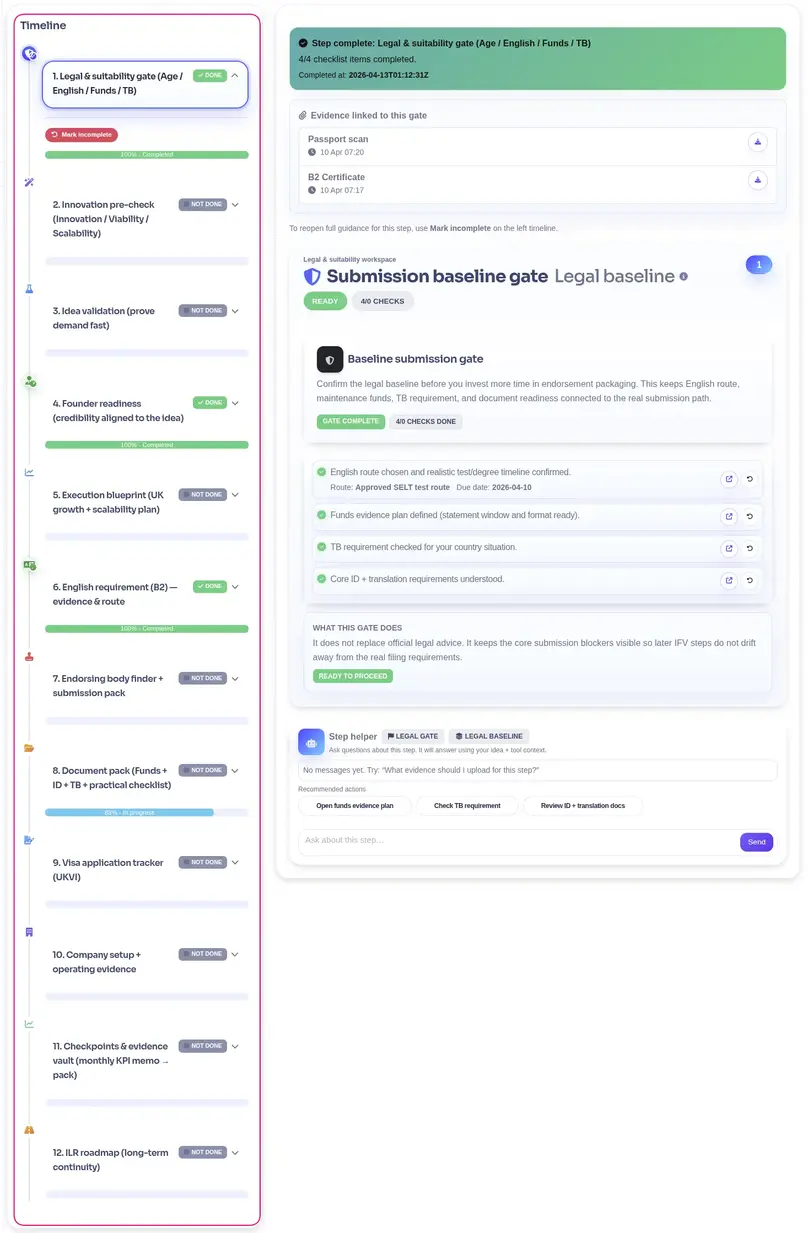
3. The core legal and practical requirements
At the official level, the route combines business criteria with immigration criteria. The business side focuses on endorsement and the quality of the business idea. The immigration side focuses on formal rules such as identity, English language, finance, and suitability. As of April 2026, the main visa application fee is £1,357 for applications made outside the UK and £1,693 for applications made inside the UK, while endorsing body fees and contact point meeting fees are separate. Official fee tables also show contact point meetings at £500 each, payable to the endorsing body.
| Requirement | What it means in practice |
|---|---|
| Endorsement | You need a valid endorsement from an authorised endorsing body before the visa stage can succeed. |
| Innovation | The business must show real originality, novelty or defensible advantage, not just a generic idea. |
| Viability | The business and founder must look realistic in terms of skills, resources, planning and delivery. |
| Scalability | The venture should show potential for growth and broader commercial development, not only self-employment. |
| English language | The rules point to English at B2 level. |
| Maintenance funds | Applicants usually need to show £1,270 held for 28 consecutive days, unless an exception applies under the rules. |
| Documents | Passport, endorsement, financial evidence, English evidence, TB certificate where required, and translations where needed. |
The official maintenance requirement remains easy to misunderstand. It is not startup capital and it is not proof that the business itself is funded. It is a personal maintenance requirement. The same is true of English: it is not a business credibility factor but a formal immigration rule that still has to be satisfied separately.
4. What endorsers are really looking for
Although the formal language is “innovative, viable and scalable”, founders usually need to translate those words into commercial reality. An endorser is effectively asking questions such as:
- What is genuinely different here?
- Why would the market care?
- Why is this founder the right person to build it?
- What proof already exists that this can work?
- Can this grow beyond a very small operation?
That is why many weak cases fail long before immigration law becomes the issue. The idea may be loosely described, the founder may rely on broad optimism, the differentiation may not be defensible, and the supporting evidence may be scattered or missing altogether.
5. What strong founders do before seeking endorsement
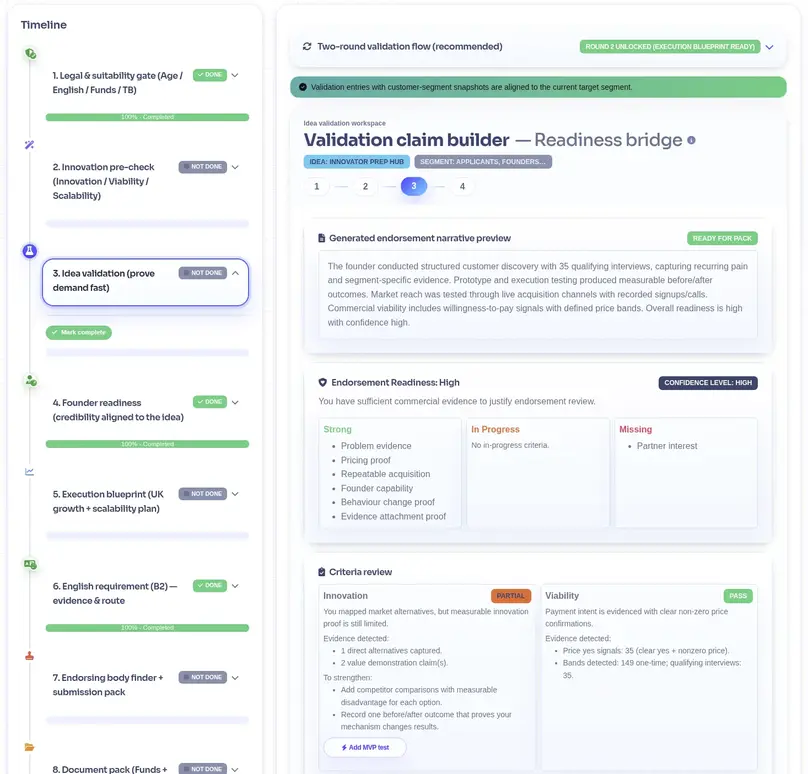
Stronger applicants usually build evidence before they seek endorsement. That evidence often includes customer interviews, problem validation, pricing signals, landing page tests, pilot results, competitor mapping, founder-role clarity, and early commercial logic. In other words, they do not rely on writing alone. They create a body of proof.
This is where your IFV product becomes useful beside the official route. Instead of treating research, interviews, notes and assumptions as separate fragments, the product gives founders a structured place to capture and organise them. That turns “I think this business can work” into “I have measurable evidence that this problem exists, that users respond, and that the business case is improving.”
6. Mixing the official criteria with a practical founder workflow
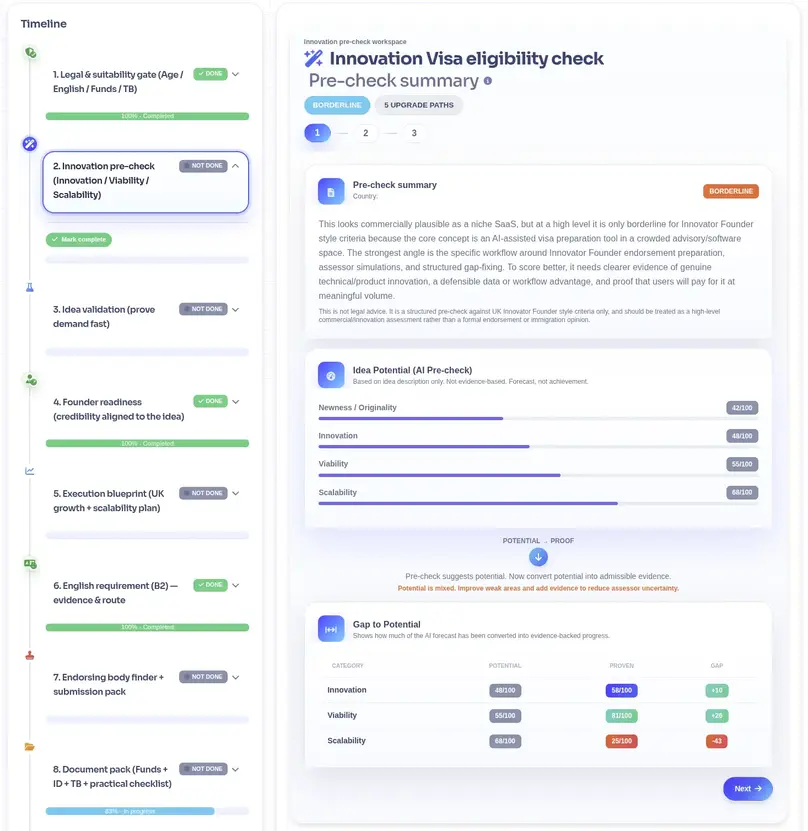
Official guidance gives the legal structure. A founder still needs a working method. This is where the IFV system can sit naturally inside the route rather than outside it.
How the IFV product fits each stage
- Before endorsement: capture interviews, tests, proof signals and evidence trails
- During preparation: convert raw activity into structured claims and validation logic
- Before submission: assess readiness across innovation, viability and scalability
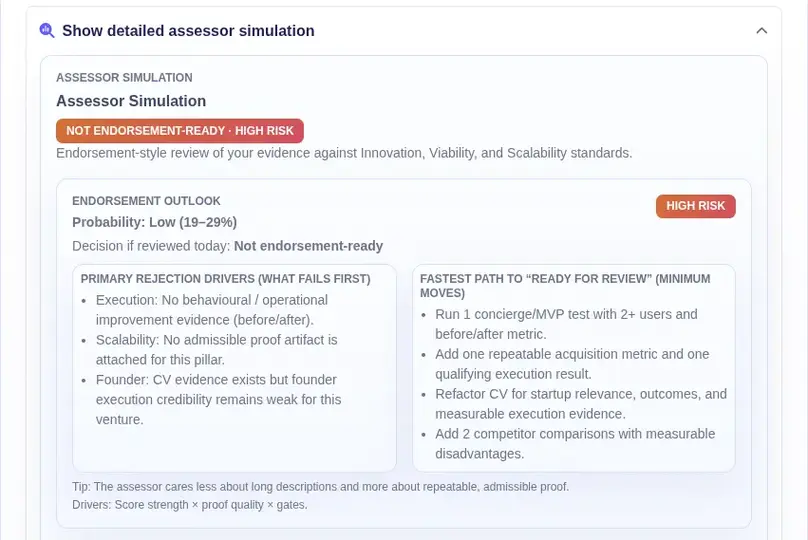
- After review: identify blockers and improve weak areas before approaching endorsers
This matters because the legal route expects more than a promising concept. It expects a founder who can show discipline, commercial reasoning and evidence of serious preparation. The product helps bridge the gap between startup activity and endorsement-ready structure.
7. The endorsement letter is a compliance document, not just a recommendation
Once a founder secures endorsement, the quality of the endorsement letter itself becomes critical. It is not just a supportive reference. It is a structured legal-compliance document that must be valid under the rules. Founders often underestimate this point and treat endorsement like an informal approval.
In practice, the endorsement must come from an authorised organisation, remain valid at the relevant time, and match the route properly. If support is later withdrawn, or if the endorsing body is no longer in the required position under the system, the founder’s immigration position can become vulnerable. Caseworker guidance published in February 2026 also shows the consequences that can follow where endorsement support ends or an endorsing body is removed.
8. Why gap analysis matters before submission
The most expensive mistake is often not refusal itself but applying too early. A founder may have worked hard, built a draft plan and even collected some useful signals, but the case still may not be strong enough. A better approach is to identify weaknesses before an endorsing body does.
This is another useful place for your IFV product to sit directly beside the official process. A founder can use the system not only to collect evidence but also to test how complete the case looks. That means checking whether the innovation claim is too vague, whether customer proof is weak, whether scalability is asserted but not demonstrated, or whether the founder’s role and execution capacity remain underdeveloped.
9. From evidence to an endorsement-ready case
By the time a founder approaches an endorser, the goal should not be “write a good plan” in the vague sense. The goal should be to present a coherent case that connects:
- the problem and why it matters
- the solution and why it is different
- the evidence that customers or users respond
- the founder’s ability to execute
- the commercial logic and growth path
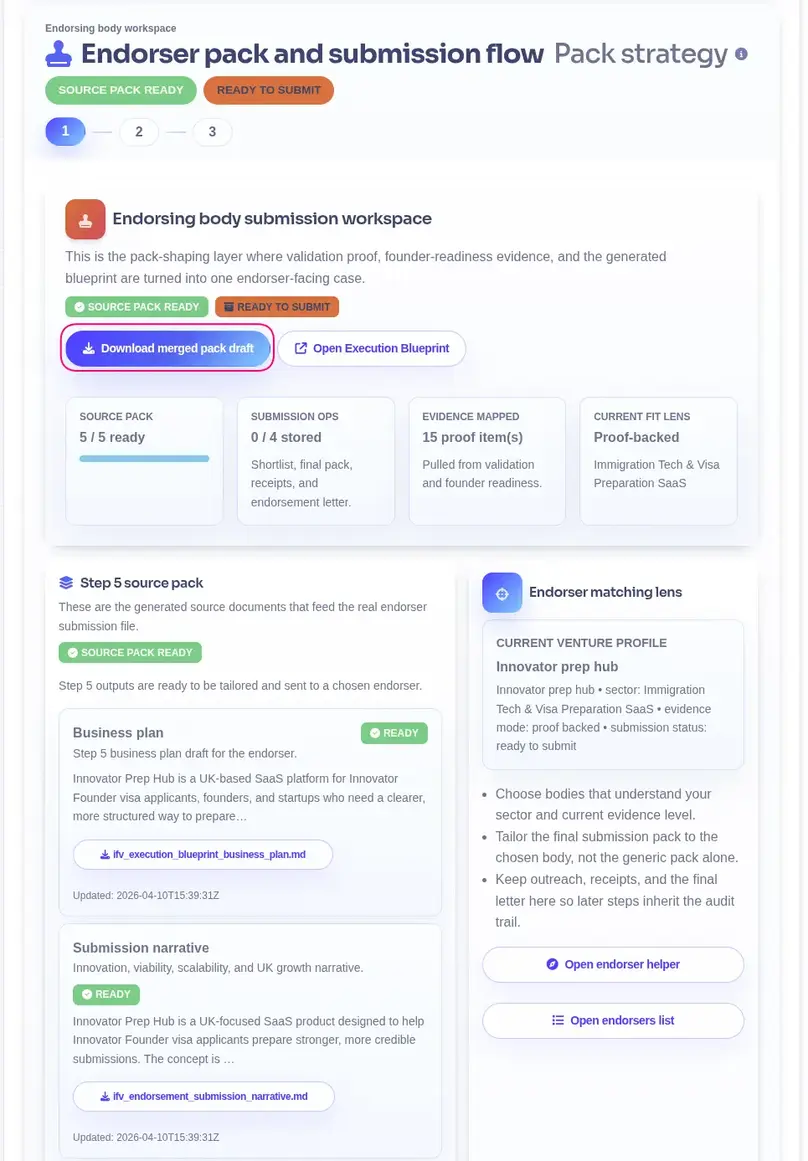
This is where your product can move beyond being a content tool and become part of the founder’s operating system. Instead of leaving interviews in one place, notes in another, and assumptions in memory, the system helps turn all of that into a more structured evidence narrative that is closer to what an endorsement submission actually needs.
10. The immigration stage after endorsement
Once endorsement is secured, the founder moves into the formal immigration stage. The official visa overview continues to state that applications can be made from outside or inside the UK where the route allows, that the normal decision aim is 3 weeks for applications outside the UK and 8 weeks for applications inside the UK, and that successful applicants are normally granted permission for 3 years.
At this stage, founders should check that the endorsement remains valid, prepare identity evidence, prepare financial and English evidence, confirm whether a TB certificate is required, and ensure that any non-English documents are translated properly. The legal side becomes more visible here, but it still rests on the credibility of the endorsement stage that came before.
11. After approval: compliance, monitoring and settlement
A common mistake is to think the route ends with visa approval. It does not. The endorsing relationship continues. Official guidance for endorsers includes contact point meetings after 12 months and 24 months, and the route depends on continued business progress rather than one successful application moment frozen in time.
Longer term, the route can lead toward extension and, where the requirements are met, settlement. The official rules and linked settlement route make clear that the business and the founder’s role remain central throughout. This reinforces the larger point of the article: the route is not about submitting one persuasive pack and disappearing into ordinary life. It is about building and running a real business under an endorsed route.
Build your case with more structure and less guesswork
Most articles stop at explanation. The harder part is turning explanation into action. The IFV product is designed to help founders collect evidence, measure readiness, understand weaknesses early, and move toward a more coherent endorsement-ready case.
Open the IFV Product Read More IFV Guides12. Final conclusion
The Innovator Founder route works best when understood as both a business evaluation process and an immigration process. The official rules explain the legal framework, but the founder still has to do the commercial work needed to justify endorsement.
That is why the strongest applicants do more than prepare documents. They validate, organise evidence, identify weaknesses, improve their case before submission, and treat endorsement as a serious gate rather than a formality. Used in that way, the IFV product does not replace the official route. It helps a founder navigate it with more structure, more visibility, and less guesswork.
Official pages worth linking beneath the article
More...
Ready to check if your startup actually qualifies?
The Innovator Founder visa is not about having an idea — it is about proving it. The next step is to test your business against real endorsement criteria, identify gaps, and structure your case around innovation, viability, and scalability before applying.


